Build v Buy in Supply Chain AI: Where Most Go Wrong
AI in supply chain is no longer a question of if - it's a question of pace.

87% of organizations have already adopted AI in forecasting. The supply chain AI market is predicted to grow by 17x and reach over $230 billion by 2035. 94% of companies plan to use AI for decision-making.
Early adopters are already pulling ahead - cutting logistics costs by 15%, improving inventory levels by 35%, and lifting service levels by 65%.
The question now isn't whether to move. It's how far behind you can afford to fall.
Teams that are 12–18 months into their AI journey are hitting the same wall: retrieval that breaks under real-world data, latency that compounds at scale, systems built for clean inputs in a world that delivers anything but. The challenge has shifted from proving a pilot to building something that holds up in production.
That inflection point brings every organization to the same decision: not whether to use AI, but what to build and what to buy.
Get it wrong and you spend 18 months rebuilding what you could have bought.
Get it right and it transforms your operations, securing a competitive advantage that compounds over time.
This article will help you get it right.
The Real Challenge Isn’t Technology
Most AI build vs. buy frameworks assume clean data, stable workflows, and well-defined problem boundaries. Supply chain has none of those. It runs on fragmented data, absorbs constant disruption, and operates across interconnected functions that don't fit neatly into a vendor's use case library.
Generic guidance fails here not because the frameworks are wrong, but because they were never designed for this environment. That's why domain experience isn't a differentiator. It's a prerequisite.
Below, we breakdown why AI is so difficult to implement in supply chain:
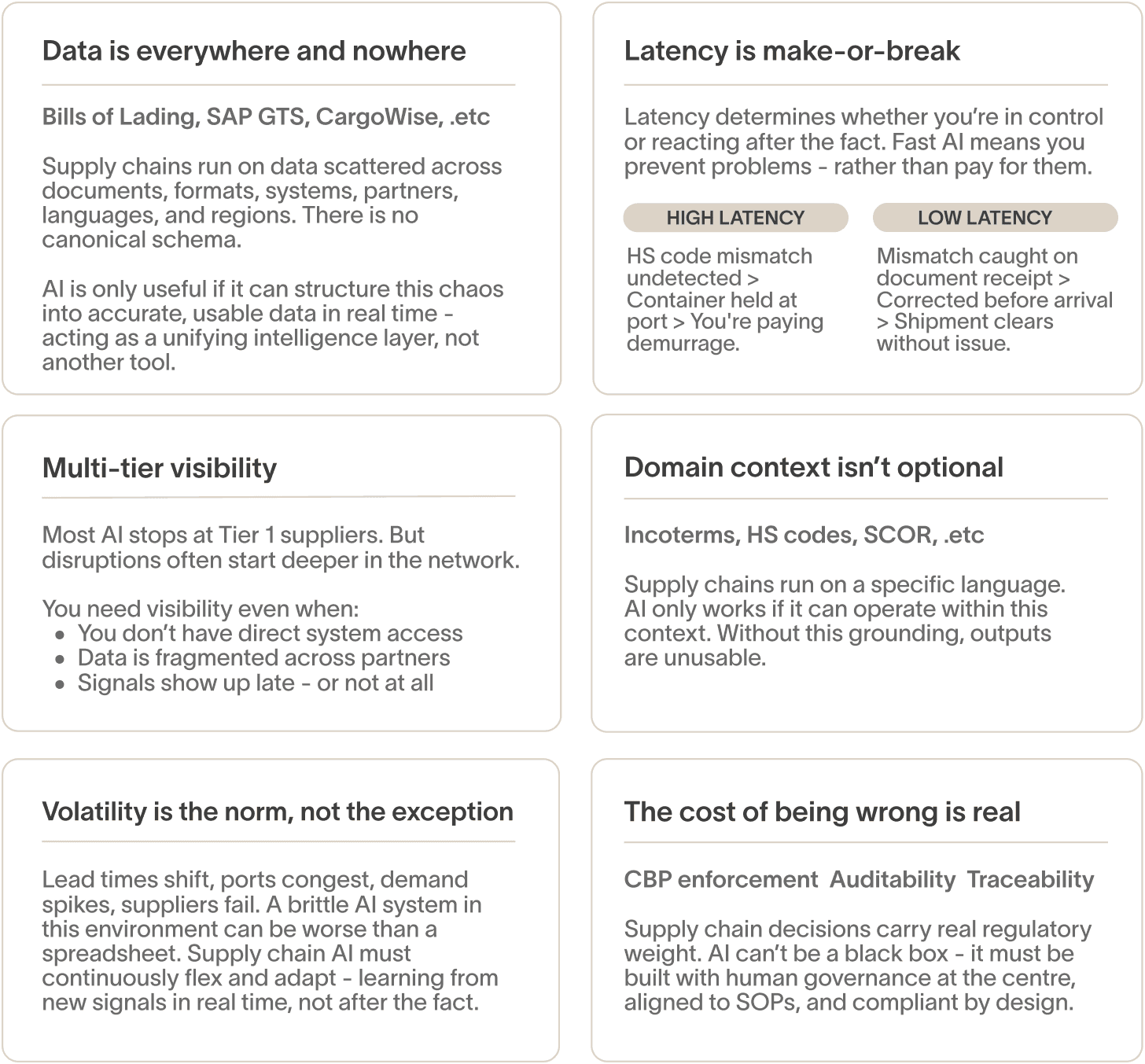
The AI Stack: Where to Build, Where to Buy
The build vs. buy decision isn't a single choice, it's a set of choices across a layered stack of capabilities, where each layer depends on the one below it.
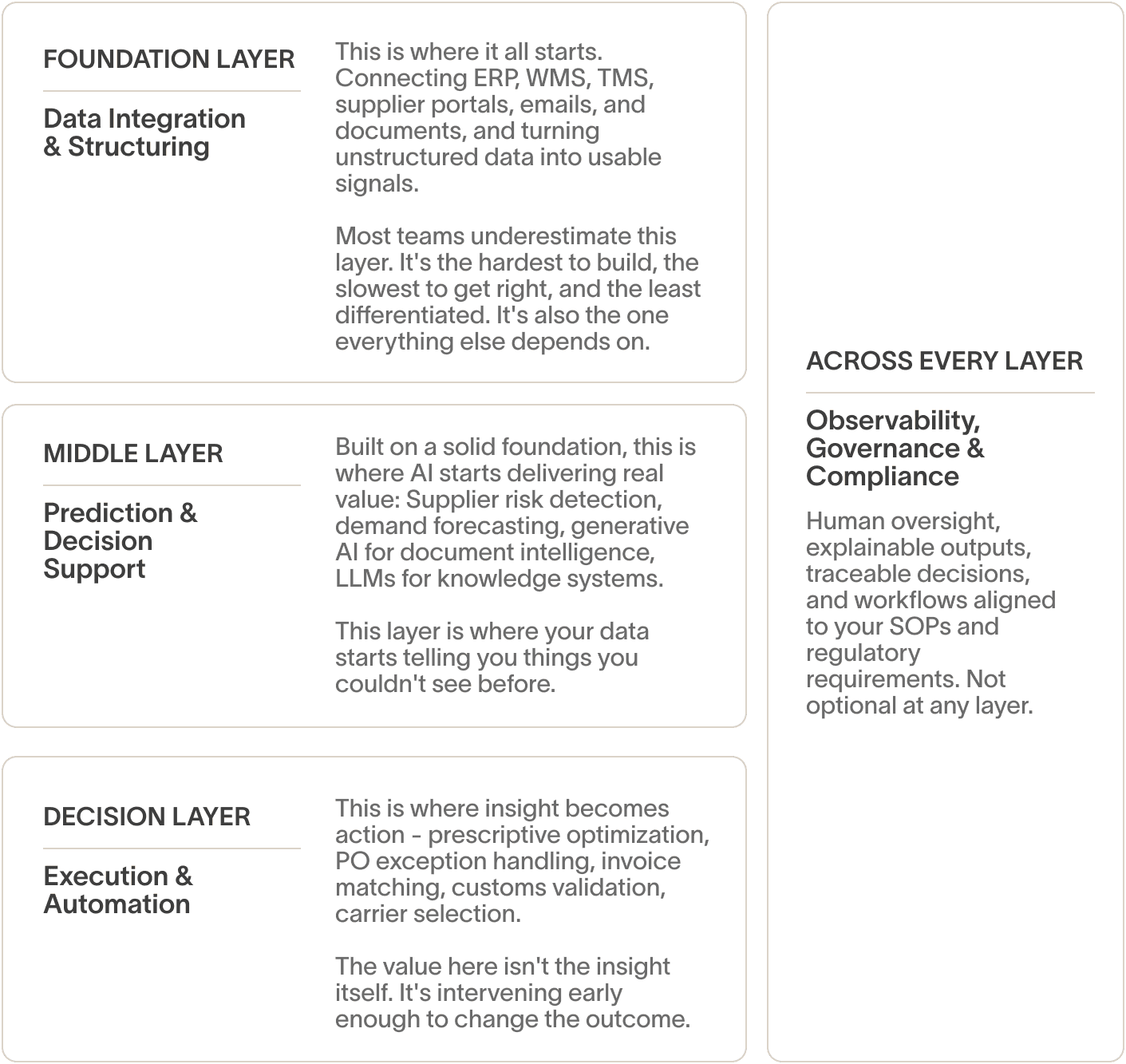
The real debate is not over build or buy, but over which layers of this stack to own. Each layer depends on the one below it - and most teams focus on the top while underestimating the foundation.
The Decision Framework
The most effective AI strategies don't default to building everything or buying whatever looks best in a demo. They draw the line deliberately, evaluating each capability in context, based on data, constraints, and where they actually have leverage.
In practice, the right answer almost always sits in a hybrid approach:
Buy the foundation. Data ingestion, document handling, standard workflows - these are proven capabilities that already exist. Building them from scratch is slow, expensive, and unlikely to outperform what's available from a specialist provider.
Build where you have unique leverage. Proprietary data, unique processes, competitive differentiation, these are worth investing in. This is where your specific knowledge of your network, your customers, and your operations creates something a vendor can't replicate.
The best approach is to buy a proven, industry-specific platform, one built to handle the complexity of real supply chain data - and build on top of it where you have something genuinely unique to add.
Use the decision flowchart below as a starting point. Every supply chain organization is different, but the underlying questions are consistent.
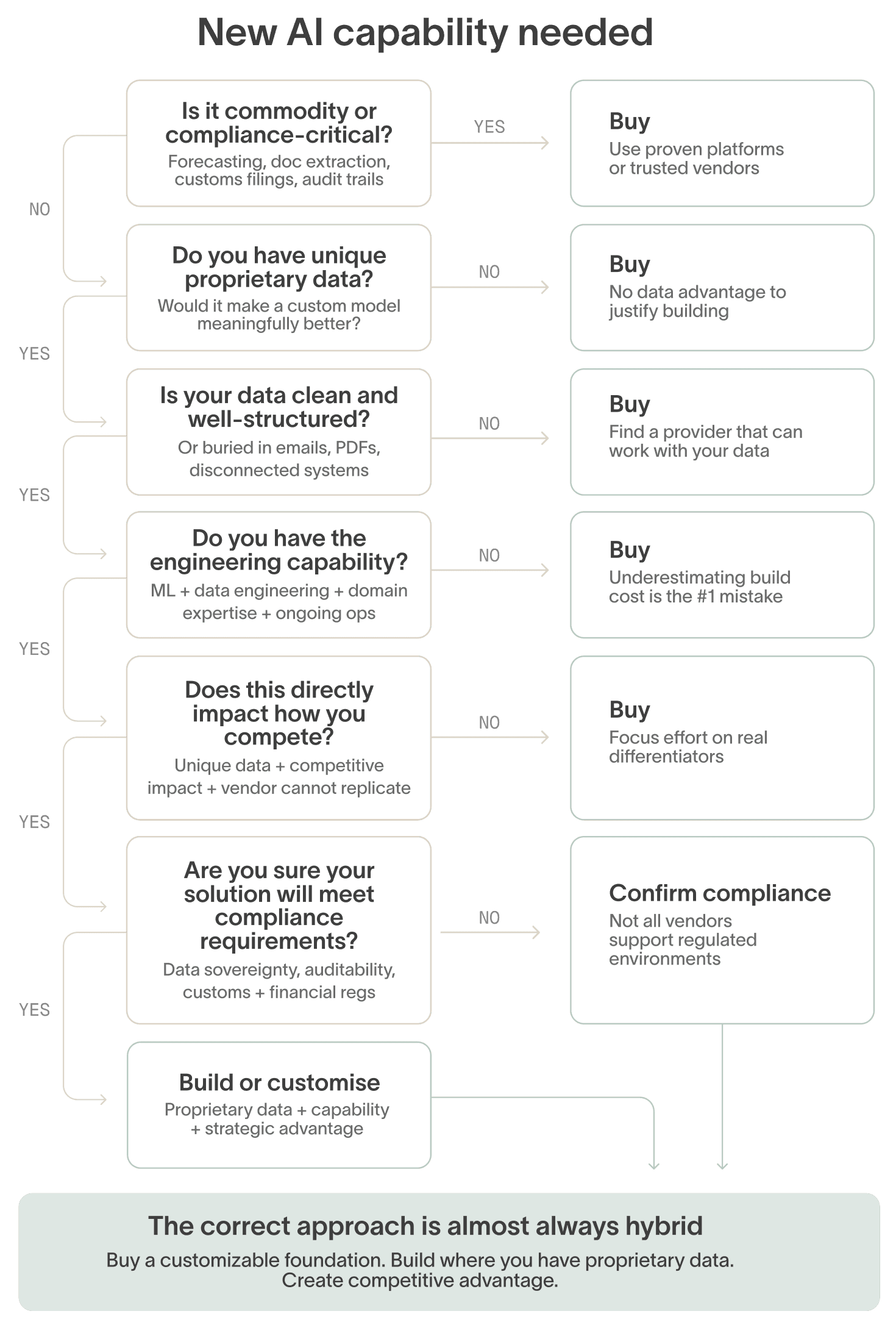
Common Mistakes Derailing AI Projects in Supply Chain
Most supply chain AI failures aren’t technical - they’re structural and behavioural, and the same patterns show up repeatedly.
BuildingRebuilding what already exists: Teams spend months building document extraction for invoices, BOLs, or customs forms - proven capabilities that are already available from trusted vendors. Underestimating lifecycle cost: Models require continuous monitoring, retraining, and adaptation after deployment as data and conditions change. Treating AI as a data science project: Supply chain AI lives in operations - customs workflows, AP processes, exception handling - not in notebooks. If it doesn’t integrate into real workflows, it doesn’t get used. No clear ownership or governance: If a customs filing is wrong or an invoice is mismatched - who is held accountable? Without clear ownership, trust in the system erodes quickly. | BuyingBuying on demos, not reality: You need to evaluate the solution beyond trying it with clean sample data prepared for demos. Use real inputs - messy invoices, inconsistent shipping documents, fragmented systems. Look for proven providers with relevant case studies. Locking into the wrong data model: Some platforms abstract or trap your data, making it hard to access, audit, or move providers. This becomes a long-term constraint that’s hard and expensive to get out of. Assuming “good enough” without benchmarking: ERP-native or generic solutions may check the box - but fail on real operational edge cases like customs discrepancies. You need to carefully measure performance and set goals to ensure your solution is effective. Scaling before proving value: Signing multi-year contracts before validating performance in a real workflow creates risk and limits flexibility. |
BothMaking a single, blanket decision: Treating all AI capabilities the same - rather than evaluating them individually - usually leads to poor outcomes. No clear definition of success: Without clear metrics (e.g. the 10x faster customs clearances and 80% reduction in errors achieved by our solutions) it’s impossible to evaluate impact. Underestimating change management: If your operators don’t support the change - or don’t trust and understand the system - it won’t be used, and won’t deliver value. A recent study on enterprise AI adoption found that 31% of employees admit to actively resisting their company’s AI initiatives, highlighting how critical change management is. It’s not just about training. It’s about finding champions, embedding AI into existing workflows, making outputs explainable, keeping humans in the loop, and starting with high-impact use cases that clearly demonstrate value. | |
Overall, most failures come from misjudging where the real complexity lies. Usually, the problems don’t lie with the models, but with issues in the data, workflows, and operational context around them.
Evaluating Your AI Readiness
If you want to move faster on AI adoption, start here - this white paper gives you the exact framework to assess where your operation stands, avoid costly false starts, and take the next step with confidence.
Where To Draw the Line
Build vs. buy isn't a decision you make once. It's a decision you keep making - across customs, AP, planning, and logistics - as new capabilities emerge and your operations evolve.
The good news is that the path is clearer than it's ever been. The teams getting the most value from AI aren't the ones with the biggest budgets or the most data scientists. They're the ones who decided by use case, drew the line deliberately, and chose partners who understood the environment they were operating in.
In supply chain, the challenge has never been getting AI to demo well. It's getting it to work when the data is messy, documents don't match, and the cost of being wrong is real. That's a solvable problem - and the organizations solving it are building advantages that will be very hard to close.
If you're ready to move from pilot to production, book a call with Raft to see how leading freight forwarders and customs brokers are making it work.


