Where Is AI Taking Supply Chain and Is Your Organization Keeping Up
What UPS, Imperative Logistics, and Dynamo Ventures Really Think About AI in Supply Chain

Earlier this year, we brought together a select group of senior leaders for a candid conversation on how AI is fundamentally reshaping supply chain.
With David Poldruhi (VP Customs Brokerage, UPS), Ian Aguilar (CTO, Imperative Logistics), James Coombes (CEO, Raft), and Jon Bradford (Partner, Dynamo Ventures) in the room, the discussion brought together three critical perspectives: the operator, the builder, and the investor. When these viewpoints collide, the insights don’t just add up - they compound.
One theme emerged repeatedly throughout the discussion: AI’s greatest opportunity in supply chain is its ability to scale human expertise and capacity.
In this article, we go behind the scenes and share key takeaways from the discussion.
From Hype to Execution
It quickly became clear that supply chain leaders were no longer debating whether AI should be used - this has already been proven. What matters now is execution:
How should AI be implemented in supply chain?
What are the key change management challenges and how can they be overcome?
Where does AI drive the most value in supply chain?
What does the future of AI in supply chain look like?
Key Insights on AI Implementation
Many organizations struggle to implement AI, prove its value, and manage the change. The panel shared insights on how supply chain organizations can overcome these challenges.
Where to start implementing AI
Many organizations struggle not with AI itself, but with implementation and change management. The panel emphasized a simple principle: start narrow, then scale. Successful teams begin with a specific workflow where AI can:
Relieve operational pressure by increasing capacity
Deliver clear value
Produce measurable results
Once that use case succeeds, organizations can expand from a position of credibility and proven impact.

Take a step back and really think about it — how can I make applied AI a real game changer? Find a very specific business process that has a high rate of success, get that pilot going, get a little bit of momentum, and then build on that.”
David Poldruhi
VP Customs Brokerage, UPS
Consider AI a growth tool
Reframe AI internally as a growth tool, not just a cost-reduction initiative. Positioning AI purely as automation can limit its perceived value and create internal resistance. When AI is presented as a growth driver it is far easier to secure leadership alignment, unlock budget, and engage the teams responsible for making it work

"Technology is all about people. It has to be leveraged, it has to be implemented, it has to be used."
Ian Aguilar
CTO, Imperative Logistics
How to prepare your organization for AI
Lead with people, not technology - every implementation decision should start with who is affected and why they should care, both for the customer and for the individual employee.
Use marketing muscle internally - apply marketing communications discipline to internal communications around change - keeping it aligned, focused on results, and relating to pain points. This can feel like overkill, but it helps move the operating team.
Manage expectations ruthlessly - most AI projects don't fail because the technology fails; they fail because the goalposts were never clearly set. Without that clarity, any shortcoming feels like failure. Teams need to know:
What exactly are we solving?
What percentage of the problem will this address?
What will it NOT solve?
Consider fluidity - technology moves fast, so you have to set expectations that the solution itself will evolve. Locking people into a fixed picture of what AI will do is a setup for disappointment.
Driving Value from AI in Supply Chain
The panel provided actionable insights into where AI can drive the most value and how to make the most of it.
Automate the 80%, elevate the 20%
AI can handle 80% of routine processes, freeing expert talent to focus on high-impact decisions, relationship management, and other activities that differentiate your services and deliver value for customers. In supply chain, organizations should focus on selling the 20% rather than the 80%.

“For those people in the industry for long periods of time that are planning and retiring at some point, capturing that information and knowledge, I think it's going to be important.”
Jon Bradford
Partner, Dynamo Ventures
Capture institutional knowledge
Many supply chain organizations rely heavily on experienced operators who have built up years of expertise. When they leave, much of that knowledge leaves the organization with them.
Agentic AI systems offer a new possibility: learning from historical decisions, operational patterns, and contextual signals to preserve and replicate expert reasoning. Over time, this creates a form of institutional memory that can guide future decisions and support less experienced operators.
"It's a lever game, a multiplier game"
Ian Aguilar
CTO, Imperative Logistics
AI is a force multiplier
AI's role is not to replace people but to amplify what they can do and increase operational capacity. This is especially true in lean, growth-oriented organisations.
The Future of AI in Supply Chain
The group also discussed how quickly AI adoption will reshape the industry and impact job roles.
Will AI put jobs at risk?
In supply chain, there is so much demand and so few skilled people that AI won’t eliminate roles, but it will change them. Work will shift significantly toward higher-stakes tasks that require humans to make decisions.
"I like to think we're going to get a lot further in five years than people expect. If you're not on the front edge of that, you're going to be on the bottom half."
Jon Bradford
Partner, Dynamo Ventures
What does the next three years look like?
The panel predicted that organizations that fail to adopt AI in the next five years will fall into the bottom half of the market. Below is the expected timeline and key milestones.
Milestone | Predicted Year |
AI adoption becomes table stakes in supply chain | 2026–2028 |
Customers routinely arrive via AI search | Already beginning |
Bespoke AI builds threaten enterprise software | ~2 years |
The consensus was clear. AI will soon be table stakes in supply chain. The differentiator will be a disciplined, well-governed application that increases capacity and brings value for customers - not rushed experimentation.
If you’re exploring how AI could reshape your operations, we’d be happy to show how Raft approaches these challenges. Schedule a personalized demo to see how Raft can improve workflows, increase capacity, and reduce complexity across your operations.
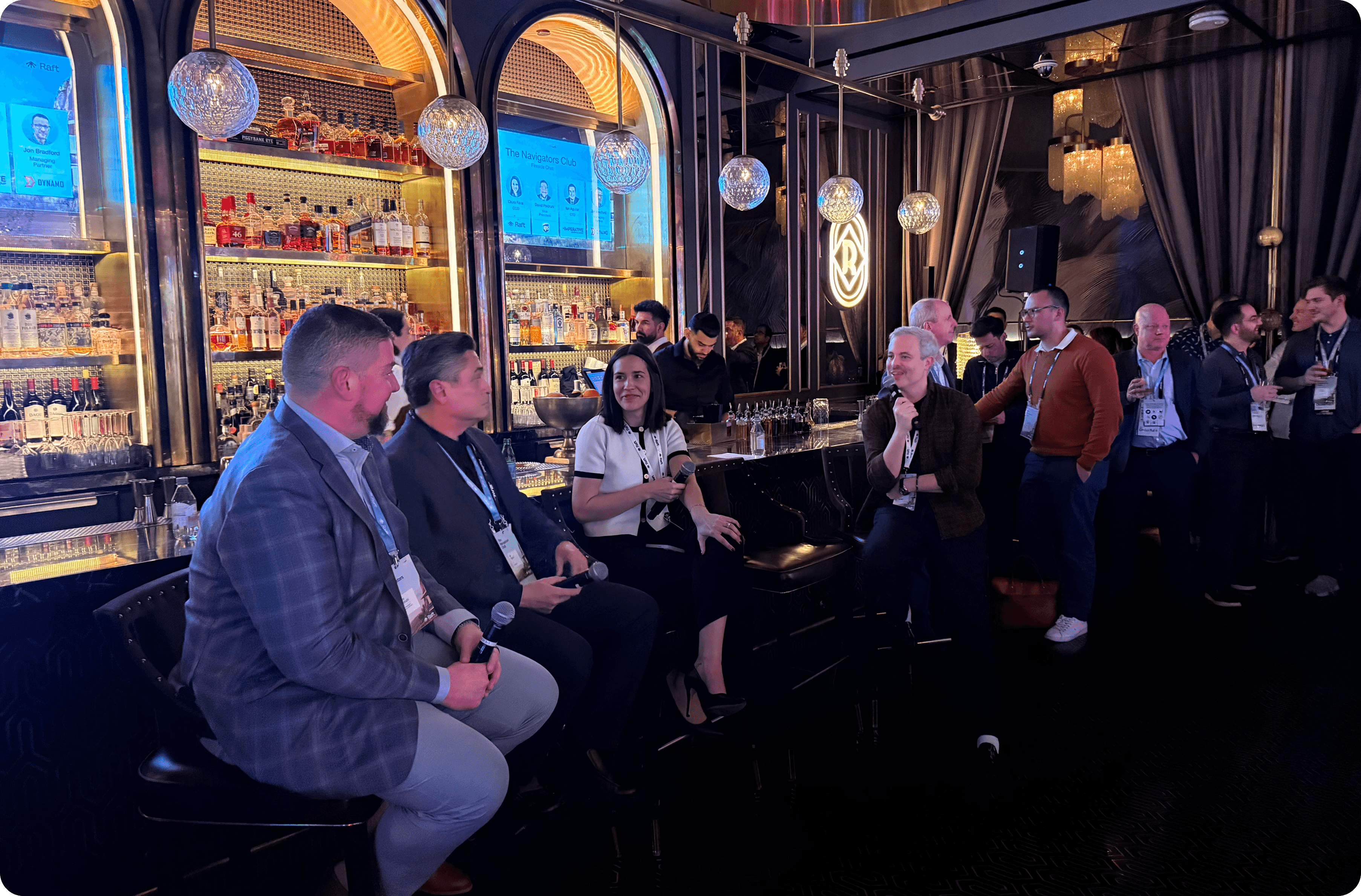
From left to right: David Poldruhi (UPS), Ian Aguilar (Imperative Logistics), Laura Flava (Raft), and James Coombes (Raft).


