When Your Experts Leave, How Can You Keep Their Expertise?
How Agentic AI Captures Your Best Operators' Knowledge Before It’s Gone

The most valuable asset in any freight forwarding or customs brokerage operation is the judgment of its best operators. It is also the least protected.
90% of supply chain leaders say their organizations lack the talent and skills to deliver on their digitization goals. Replacing a single experienced employee costs between 50% and 200% of their annual salary. When senior people walk out the door, two decades of pattern recognition walk with them.
The previous installment in this series covered context engineering - how AI agents retrieve the right information at the right moment to make reliable decisions. The most important context is the persistent memory layer: the accumulated record of how your best people have handled past situations.
This installment is about how that layer actually gets built - and why decision trace is the difference between a system that learns from your experts and one that merely logs what they did.
Refresher: How Decision Trace Relates to Agentic AI
So far we've established that an agent is reasoning + tools + memory working together toward a goal. That trust is what earns agents the right to move from Recommend, to Approve, to Execute. And that context engineering - deciding what an agent sees at each step - is what separates one that performs like your best operator from one that confidently makes the wrong call.
Decision trace is what connects all three. It's how the memory layer grows - and how earning greater autonomy becomes possible in the first place.
Decision Trace: How Agents Learn From Your Experts
A decision trace is a structured record of how a decision was made - not just what happened, but why. It captures the situation the agent encountered, the data it retrieved, the policies it applied, and the reasoning it followed. And when a human stepped in - the override, and the thinking behind it.
This is more than an audit log. An audit log proves what happened. A decision trace encodes why - and makes that reasoning available to every future agent run that faces a similar situation.
Every agent already produces a step-by-step reasoning trace as it works. A decision trace wraps that in the operational context that surrounded it - the customer, the lane, the document, the rule applied, and critically, what the human did with it. That wrapper is what transforms a record of the last decision into fuel for the next one.
A decision trace typically captures five layers - and a sixth when a human steps in. That sixth layer is the most valuable of all. The diagram below shows all the layers in action - from the moment a trigger arrives, to the point a human override enters the persistent memory layer.
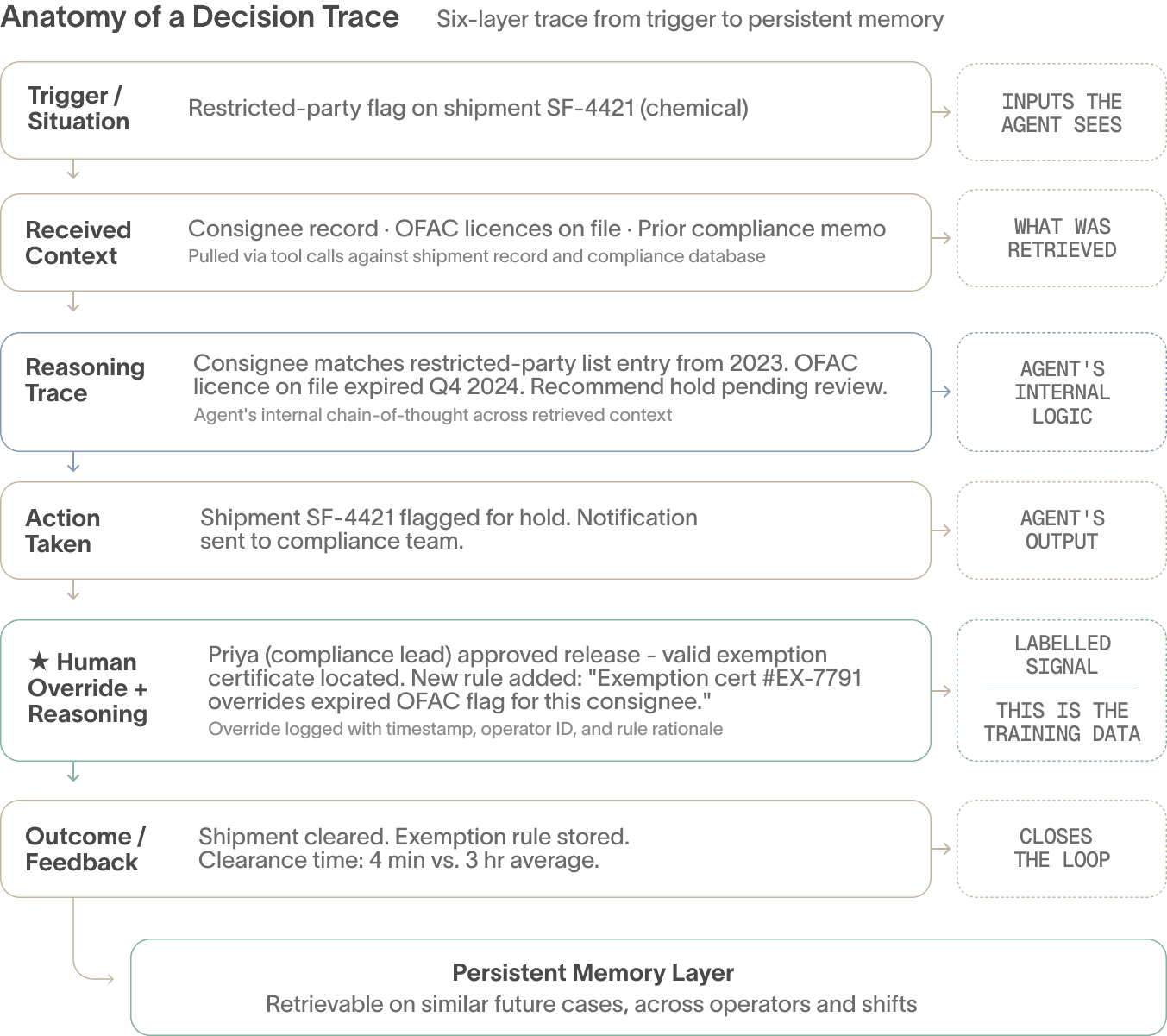
Trigger / Situation. The shipment, document, or exception that prompts the agent to act.
Received Context. What the agent retrieves from connected systems to inform its reasoning.
Reasoning Trace. The agent's internal chain-of-thought across the retrieved context - visible, traceable, and reviewable. This is what separates a decision trace from a black box.
Action Taken. The agent's output - what it did or recommended as a result of its reasoning.
⭐ Human Override + Reasoning. The most valuable layer. When a human intervenes - overriding, adjusting, or approving - and logs their reasoning, that intervention becomes the signal the system learns from.
Outcome / Feedback. What happened as a result. This closes the loop - and everything flows into the persistent memory layer, retrievable on similar future cases across every operator and shift.
Every layer feeds the next decision - here's how agents use them.
How Agents Use Past Decision Traces
When a new situation arrives, the agent doesn't apply a fixed policy. It searches the persistent memory layer for the most similar prior decisions - including past overrides and the reasoning behind them - and brings them into its working context.
It's the same instinct an experienced operator follows when they ask the colleague who's seen this exception before. The agent reasons about the new case with the relevant prior cases in front of it.
When a human intervenes - overriding a recommendation, adjusting an output, handling an escalated exception - that intervention becomes a signal the system learns from. This is the same principle the world's leading AI researchers use to improve their models - applied directly to your operation.
Over time, three things compound:
Richer retrieval. The memory layer accumulates more reference cases. Future decisions draw on a deeper base of prior context - including the edge cases your best operators have already solved.
Smarter escalation. The system learns which cases your team actually wants to see and which can be handled within tolerance - tuned to your operation, not a vendor default.
A built-in safety net. Every past human-approved decision becomes a benchmark. When the system updates, you can verify it still gets the same answers right. This is what makes expanding agent autonomy safe rather than reckless - and why context engineering and decision trace work together as a system.
Capture the Knowledge Your SOPs Can't
Your best operators carry institutional knowledge that doesn't show up in SOPs. They know which carrier's "delayed" status actually means a re-route, which document discrepancy is a real exception versus a known formatting quirk, and which customer has an invoice variance tolerance that's nowhere in the contract. That judgment is built over years - and lost the moment they leave.
The industry already knows this is the bottleneck. 45% of executives cite a lack of visibility into agent decision-making as a significant implementation barrier - meaning trust is gated on traceability, not capability. And trust in fully autonomous AI dropped from 43% to 27% in a single year. The answer isn't less AI. It's AI that shows its working - and learns from yours.
Decision trace solves both problems at once. Operators get a transparent record of every action the agent takes and the reasoning behind it. The system gets the expertise of senior operators encoded into its persistent memory - available to every shift, every location, and every team, not just the customers lucky enough to land on the right desk at the right time.
Example: How Decision Trace Changes Outcomes in Compliance
WITHOUT DECISION TRACE
Priya, a compliance manager, is reviewing a chemical shipment when the agent flags a possible restricted-party match - a consignee name closely resembling an entity on a recent OFAC update. The agent escalates. Priya checks the file, identifies the consignee as a subsidiary of a parent her team cleared six months ago under a specific OFAC general license, locates the license number in a buried email thread, and releases the hold.
Three weeks later, the same consignee appears on a different shipment, on a different operator's desk, in a different region. The agent flags it again. The operator does the same work Priya did - but slower, because Priya's reasoning was never captured. Across a year, the team repeats Priya's research dozens of times.
WITH DECISION TRACE
The moment Priya releases the hold, the system captures the full trace - the flagged entity, the parent-subsidiary relationship she identified, the OFAC license number, the documents she relied on, and her reasoning. Three weeks later, when the same consignee appears, the agent retrieves Priya's prior decision, applies the same reasoning, and releases the hold automatically - surfacing a one-line audit trail to the operator on duty: ‘Cleared under license X per Priya's prior decision, dated 12/05/2026’.
Priya's expertise isn't on Priya's desk anymore. It's available to every operator, every shift, every shipment. And every adjustment any operator makes to that pattern - a license expiration, a new entity, a changed parent relationship - refines it further.
The Compounding Advantage
Decision trace is how an agentic platform stops losing institutional knowledge. Your operators' reasoning is no longer trapped in their heads or buried in chat threads - it's applied across locations, shifts, and teams, and used to scale capacity as volume grows - without adding headcount.
It's also what makes expanding agent autonomy possible at the right speed, and the foundation that makes change management work in practice. It's the evidence base your auditors, regulators, and ops leaders need to extend that autonomy with confidence - and what separates a successful AI deployment from one that stalls at the pilot stage.
Every approved trace is a small grant of trust. Two years of approved traces is a moat.
Decision traces are built into every agent Raft builds - capturing every action, reasoning step, and human override across your operation. Designed for the audit standards of customs, the operational reality of freight forwarding, and the institutional knowledge problem at the heart of both. Get in touch for more information.


