Market by market, one shared process
How a global logistics provider is rolling AP automation across dozens of country organisations

Business Overview
A leading global transport and logistics provider operates a network spanning well over 150 countries and around 50,000 employees. Its freight forwarding business processes supplier and carrier invoices across dozens of separate country organisations.
Case Study Product Focus
Raft Finance (AP): agentic AI for supplier and carrier invoice processing, configured by country and reconciled against their TMS (CargoWise).
This forwarder also runs Raft Customs and Pre-Alerts across its global offices.

The problem
An invoice pack from a Spanish supplier does not look like one from a German supplier, and neither is filed under the same tax rules. Every country organisation brings its own creditor codes, document conventions and validation requirements, and every new market adds another combination of format, currency, tax treatment and CargoWise configuration to the pile. AP effort therefore rose with the size of the map as fast as it rose with freight volume.
Which left the work with people. In each market, a finance colleague opened the pack, read it, keyed the header and line data, matched it to the shipment, and checked it against the accrual - then the next one, in the next country, against a different set of rules. Nothing about that could be standardised centrally without overriding the local requirements each team is accountable for meeting, which is the reason global AP standardisation attempts usually stall.
Why they chose Raft
The company was buying at group scale and evaluated accordingly: enterprise-grade global AP support, alongside Customs and Pre-Alerts, across dozens of country organisations, ISO certification, and an AI provider able to cover more than one operational process across the shipment lifecycle rather than finance alone. The decisive question was rollout. A layer that had to be rebuilt for each market would take years to reach a network of this size, so the group needed local rules to be configurable - something set per country on top of one shared extraction layer - and needed proof that a market could go live in days or weeks, post initial rollout, rather than quarters.
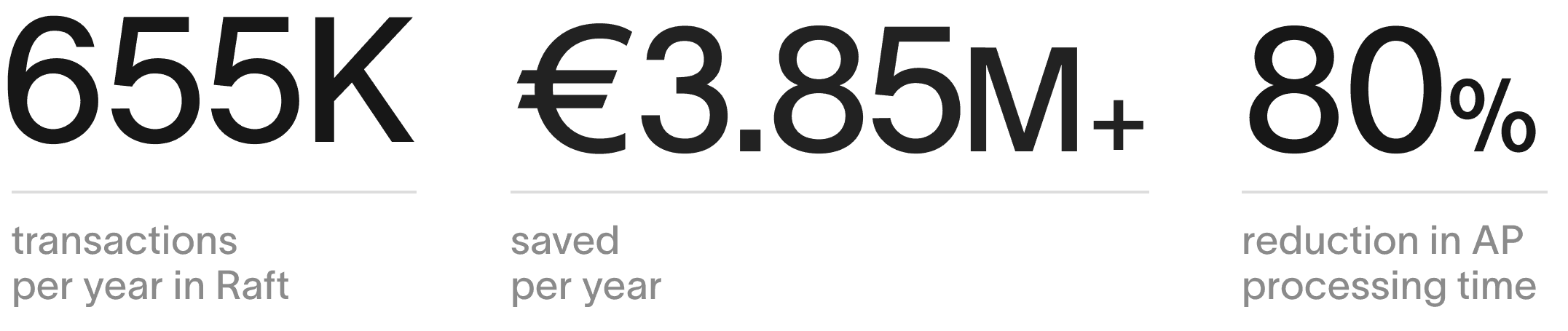
"Standardising AP across a network our size usually means asking every country to work the same way, and that never survives contact with local tax rules. This does the opposite: the process is shared, the local treatment stays local, and a market goes live in weeks rather than quarters. We now put more than 650,000 documents, emails and spreadsheets through Raft a year - my teams spend their days on the invoices that need a decision, and we can open a new country without designing a new AP process for it."
What its teams do now
Raft takes the first pass, end to end, before a person is involved. It identifies what has arrived, whether it comes in as a document, an email or a spreadsheet — multi-shipment invoices, statements, credit notes, overheads — and captures header and line-level data at 97% average accuracy driven by the agentic AI extraction studio. Then automatic validations compare the planned cost profile against the live CargoWise shipment, reconcile the accrual and post to the correct job. Genuine exceptions route to the finance team; everything else clears without anyone opening the pack. With close to three quarters of a million documents, emails and Excel sheets running through Raft annually, 61% complete with one or less human touches.
The country layer is what makes that repeatable. Creditor normalisation, tax ID handling and e-invoice field mapping are configured per market rather than rebuilt per deployment, so each country organisation keeps the local treatment it is accountable for while the group gets one process behind it.
For the finance teams themselves, the change is what a day contains. Their people no longer read packs to find the numbers; they handle the exceptions that need a decision, own the supplier and carrier relationships behind them, and carry a materially larger book of invoices per person than the manual process allowed. The group can add a market without adding a process, and its country teams can absorb more freight without absorbing more keying.


