It's time the freight industry had a dedicated harness
James Coombes

ou may recently have heard the word ‘harness’ in relation to AI. It is having a moment. To me the word ‘harness’ is such an emotive word. It brings to mind a rider on top of a champion racehorse; raw horsepower but (hopefully) with control and direction. But here’s what it means to me in a freight context.
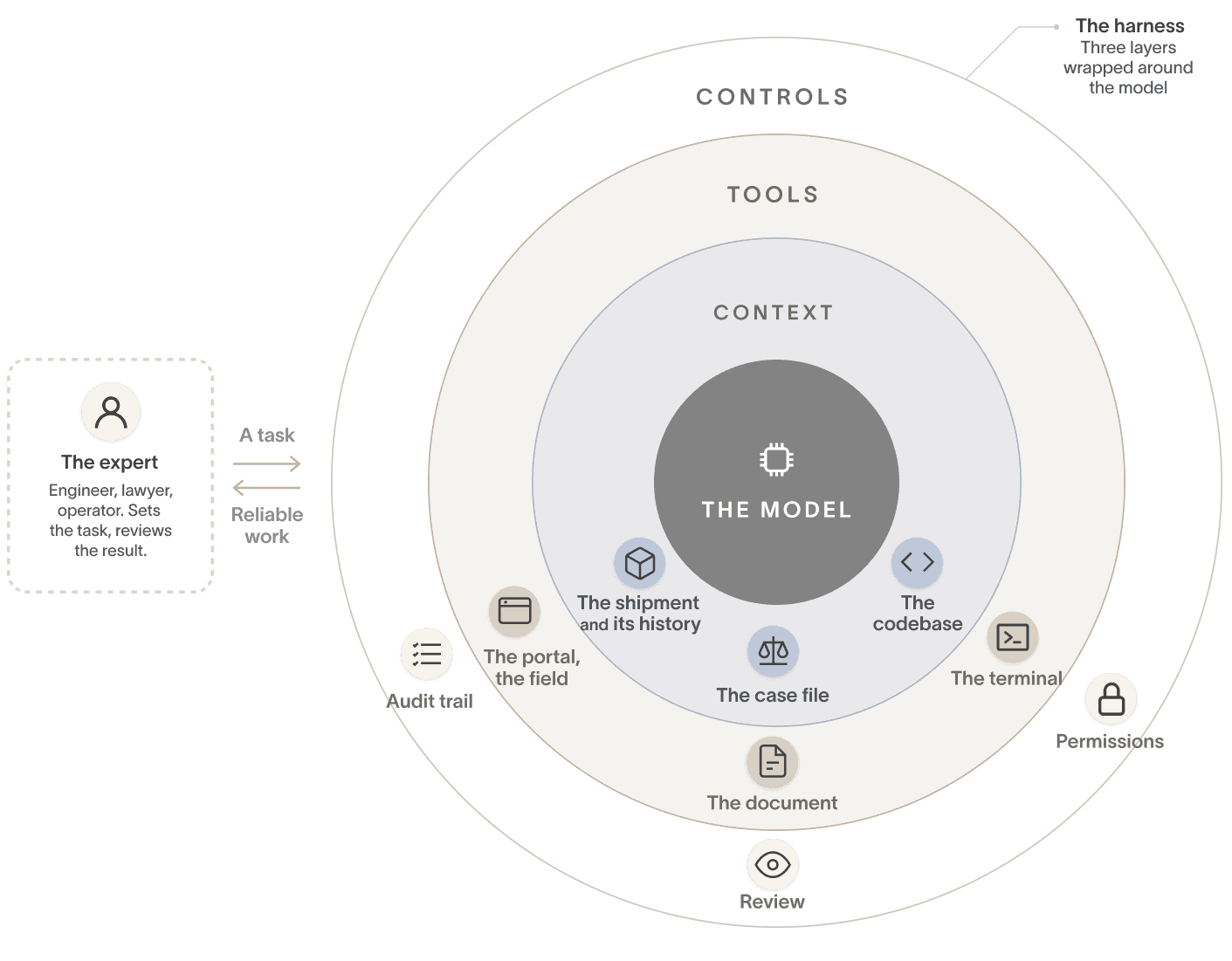
In technology, the term 'harness' was first used to describe coding AI platforms like Cursor, Claude Code and Codex. A 'harness' describes the scaffolding that wraps around an LLM and provides all the context, tools and controls an engineer needs to deliver production code effectively with agents. It's incredibly powerful.
AI coding harnesses were the first movers because the experts using the product - software engineers - were aware of the potential, but also already well-versed in the systems and interaction patterns that harnesses use. Interactions in a coding harness are largely text and code, which engineers already work with. In parallel with exceptional growth in the quality of the models themselves, this easy-adoption explains why AI coding harnesses have become so successful so quickly.
If AI coding was the most naturally aligned to agentic work, then harnesses for legal work like Harvey and Legora were probably the next best thing. The basic output - legal content and how it relates to case history - is incredibly well aligned to how both agents and lawyers work. The models themselves have been ground-breaking, but a critical factor has also been that legal harnesses have also met lawyers where they work: in documents, and as a result have rapidly shown huge value.
So where does that leave freight?
Freight execution is, on paper, close to an ideal candidate for agents. It is highly repetitive. The tasks have been well understood for decades: classify, clear, book, amend, track, invoice, reconcile. And the context is enormous - every shipment has a customer, a commodity, a corridor, a set of parties and a history.
The interface however, is very different to our coding and legal examples. A customs broker has as much hard-won expertise as a staff engineer or a corporate lawyer; just none of it happens to be expressed in the medium an agent runs in.
What a harness is
Freight harnesses have to live ‘multimedia’
Few (if any) of our users will work in the command line. And while documents might record and drive freight work, they aren't the work (unlike legal). Freight work happens at the edges, at a 'state'. A declaration accepted by customs, a booking confirmed with a carrier. A container released. Freight work is a series of 'jobs-to-be-done'. Freight work is scattered across a shipment file and it exists in email threads, customer portals, carrier portals, the PDF that arrived as an attachment, the spreadsheet someone keeps on the side, the tribal knowledge ('because Bob said so'). And that means that an agent harness for freight has to be embedded into every medium an operator has to work in. A freight agent has to turn up inside a shipment, draft into a thread that exists, fill a field an operator had to fill. This is more than just a UI preference, it's a basic requirement.
Freight harnesses have to coexist with (and feed) deterministic rules
Freight is - as you'd expect - incredibly intolerant of mistakes. Unlike code or legal, where the meaning and intent is more important than the way you wrote it, freight execution is strict and brittle on the data that informs the work. Which makes sense; if you get the port wrong or the tariff code wrong, there is no 'git revert' or undo button. It also leads to a tug-of-war between deterministic and agentic ways of working, which is a real battleground in regulated industries like freight (and others, like finance). A freight harness has to live in both realities. It needs to understand when a workflow is deterministic and repeatable, but it also has to insert agentic capabilities where the messy exceptions and human realities raise their heads above the parapet. This deterministic/agentic duality is critical for reliability, but it is also important for cost management, which is what the c-suite cares about, especially in a historically low-margin business like freight.
Freight harnesses have to be centralized and governable
A freight operation has a need for centralized control, to minimize mistakes, but also to drive consistency over the long-term. Control is probably the lever our customers value most. For a freight harness that means several things. A freight harness has to be multiplayer by default; one person using Claude Code and building their own skills is pointless when you need everyone to do the same thing and work together. Everything a harness does needs to be visible and audited. Different levels of influence over agents and exceptions have to be exercised by different roles in an organization. And the data needs to stay in the business.
But freight harnesses also have to be flexible, allowing for SOP evolution
Which brings us to SOPs (Standard Operating Procedures). Every single one of our freight customers think they're running industry best practice, but the irony is that they all do things differently. I call it the 'lasagne rule'. Everyone knows what a lasagne is. But different people might have different recipes for lasagne. Someone might use bechamel, others a cheese sauce. Everyone calls it lasagne, but everyone makes it a different way. Such is freight. Everyone in freight knows they need to submit a customs declaration, make a booking, reconcile a payment, they just all do it in a slightly different way. A freight harness has to cope with this. It needs to follow prescribed top-down SOPs for management control and optimization, but also fluid bottom-up variances to those SOPs that change depending on the time of day, the mood of the person on the other line, the macro situation in the straits of Hormuz. It constantly evolves. A freight harness has to deploy agents over that changing landscape.
Plus ça change, plus c'est la même chose.
For all of the above points, the primitives underneath a coding, legal or freight agent are identical irrespective of the harness. Freight tasks are bounded, with verifiable completion. An entry is done when it's accepted. A booking is done when it's confirmed. The loop has a terminating condition and something other than a human can check it. Freight satisfies that condition in the same way that coding, legal or any other industry does.
The extra complexity is that a freight agent has to understand the system, not just the task. Not just the shipment in front of it, but this customer, this lane, this commodity, and what has always been true about them. It needs a complete set of tools that reach the end of the job. An agent that tells an operator the booking confirmation came back is helpful but not enough. To be truly useful it has to flag whether space was confirmed on the intended vessel on the right dates and if not, what the alternative is and explain the consequences of that decision, in a predictable, controllable and auditable way.
Put another way: a freight harness is to an AI what a good operations manager is to a talented but green operator - it supplies the context, the SOPs, the tools, and the supervision that turn raw capability into reliable work.
To me all this implies an incredibly exciting time ahead for our industry. Freight has spent forty years buying software that records what happened. Systems of record, portals, dashboards, screens built to tell you where a box is once it has already moved. A freight harness is the first thing that actually does the work.
And everything it needs is now in place. The models are extraordinary. The work is well understood. The context exists, albeit scattered. The only thing that was ever missing was a harness built for the people who actually do this job. That harness now exists. We’ve built it. Which means the question for everyone in freight is no longer whether agents can do this work. It's what your operation looks like when they do.
Saddle up.