New countries and new acquisitions inherit AI-led SOPs
How a Chicago-based freight forwarder runs finance on two continents, with 90% of invoices requiring one touch or less

Business Overview
A global freight forwarder based in Chicago operates for more than 45 years with teammates across 150+ locations in Asia, Europe, the Middle East and North America, serving aerospace, energy, high-tech, home delivery, life sciences and marine.
Case Study Product Focus
Raft is deployed across the wider shipment lifecycle with the following focus areas:
Raft Finance (AP): Matches invoices, credit notes, and multi-shipment invoices to the job in the TMS, validates against the accrual, posts clean invoices, and routes exceptions to the team.
Raft Customs: Extracts and cross-validates commercial invoices, packing lists, and supporting BoL; agents driven by broker-set SOP pull entry-related data for broker decision and review prior to their TMS push.

The problem
In each of more than a dozen country organizations, a member of the local finance team opened every supplier invoice and keyed it into CargoWise by hand. Each faced a supplier base, a set of document conventions, a tax regime and a system configuration that were theirs alone, and rules only their team held. Every new market added its own combination of format, currency, tax treatment and configuration, so the company's finance effort scaled with its country count as well as with its freight volume. And the business kept adding countries, and kept acquiring businesses that arrived with finance processes of their own, each needing to be folded into one way of working.
The variation was not only in the documents. It was in who entered costs, and when. In some regions operators processed their own AP invoices instead of finance, and would not enter an estimate until the supplier invoice arrived, so a shipment could sit with no cost against it for as long as the invoice took to turn up. What looked like a local working preference surfaced at month-end as a P&L that did not reflect the work already done.
The customs desk carried the same underlying constraint. The business sells clearance speed, so entries are assembled from multiple supplier invoices, each running to a dozen or more lines, while the freight is still moving. Under the reasonable care standard, the broker owns entry accuracy regardless of what produced it.
In each case the work waited on a document: someone reading it, someone keying it, or someone holding off until it arrived.
Why they chose Raft
The company was buying for an enterprise, not a department. It needed global AP and Customs support across more than a dozen country organizations, ISO certification, and one AI provider covering more than one operational process across the shipment lifecycle instead of a point tool per desk. The why-now was the group's own growth. With an active acquisition strategy and new markets opening, it needed each new entity to fold into the company’s SOPs for both finance and customs rather than add another bespoke process. It codified and centralized that SOP with Raft, with guided AI automation handling for accounts payable and customs entry preparation.
"We're a company that grows, into new countries and through new acquisitions, and intensive manual operations across the shipment lifecycle - especially within finance and customs processing - used to be the things that slowed that down. Every entity has its own way of doing the work, now the standard is in the platform. My team's expertise goes into the exceptions and the supplier relationships, our brokers spend their time on classification and valuation instead of reading paperwork, and the customer gets the clearance speed we promised them."
What its teams do now
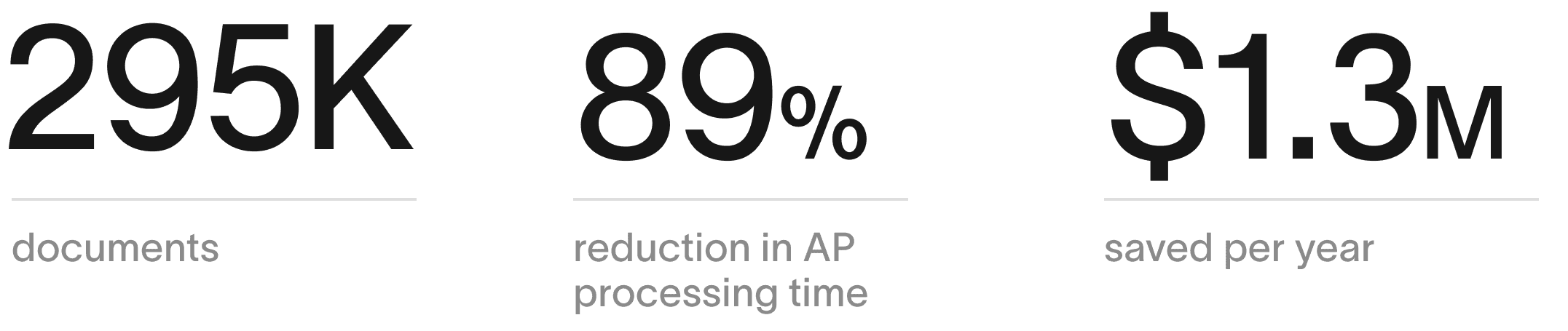
Over five years on from rollout across finance and customs, the company's teams work with agentic AI that acts on the work rather than assisting with it. In finance, it takes in the invoice pack, extracts header and line-level detail at 96% field-level accuracy, validates it against the live CargoWise record, applies the country-specific rules that used to live in local heads (creditor normalization, tax ID handling, local field mapping), filters out duplicates and already-paid invoices before they ever reach the team, and posts to the correct country configuration, escalating only what genuinely needs a person. With over a quarter of a million documents running through Raft annually, 70% of the group's invoices now complete with no human touch at all and 90% with one touch or less.
Two things follow for the organization's finance function. Its effort no longer scales with its map. Eleven European environments plus the US run on one shared extraction layer with the local treatment configured on top, instead of a dozen bespoke integrations. A new market, or a newly acquired entity, inherits the standard rather than inventing one, and the company can integrate an acquisition on its own timetable rather than its finance team's.
And the work now sits where the accountability sits. The company's European AP runs as one process under a single finance team rather than country by country, so costs are entered the same way and at the same point in the shipment across the region. It no longer depends on whether a given country's invoices happen to be handled by operations or by finance. Consistency is a property of the process rather than of the market, and month-end reporting rests on the same record everywhere.
Customs gains the same backbone. The company's licensed brokers keep classification, valuation and reasonable-care decisions, and have stopped doing the reading and keying that preceded them, which protects the clearance speed the business sells to its customers.
The group didn't automate a singular process. It adopted an AI operating standard that now runs across teams, two continents, and every entity it adds.


